Calculation method
From Area and Depth to Material Volume
Area describes the footprint; depth turns that footprint into a volume.
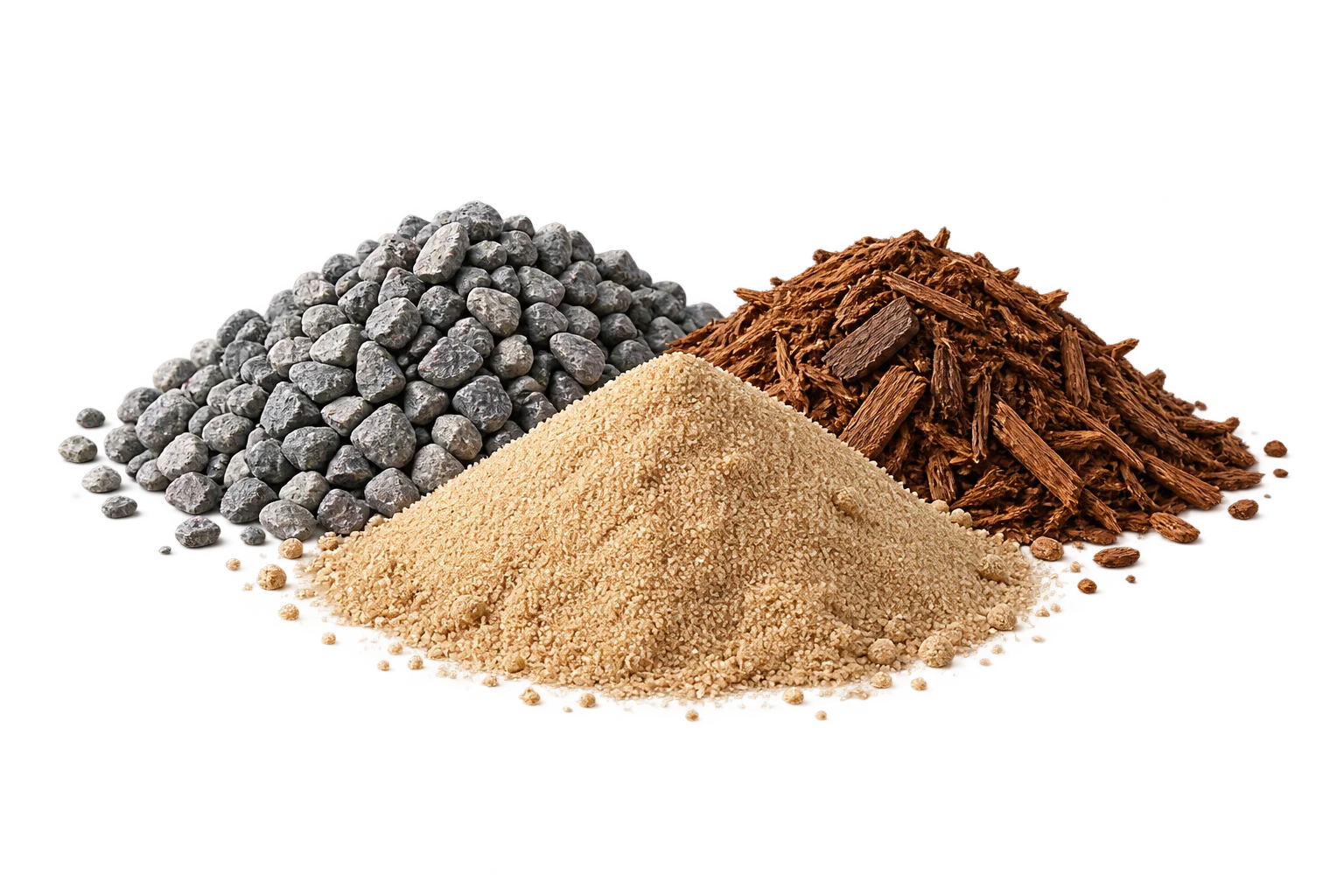
Keep the two inputs separate
The area is the surface that will receive a material. The depth is the thickness of the layer represented by the estimate. They answer different measurement questions. Two materials can use the same footprint while requiring different depths and separate volume calculations.
This method calculates the layer you enter. It does not select a suitable depth for gravel, sand or mulch, and it does not apply an unentered compaction or settling factor.
Use compatible area and length units
If the area is in square metres, express depth in metres before multiplying to obtain cubic metres. For example, a 50 mm depth is 0.05 m. Multiplying 20 m² by 0.05 m gives 1 m³.
An area unit already contains two length factors. Do not convert square feet to square metres by using only the linear foot-to-metre factor. The same dimensional care applies when displaying cubic yards, cubic feet or litres.
Build a multi-zone example
Suppose one measured zone has an area of 8 m² at a chosen depth of 0.05 m, while another has an area of 12 m² at 0.08 m. Their volumes are 0.4 m³ and 0.96 m³, for a net total of 1.36 m³.
An unweighted average of the two depths would not generally describe the combined layer. Calculate the volume of each zone before adding them. A chosen 10% allowance on this total gives 1.496 m³.
Deduct an area only on the right depth basis
An excluded rectangle can reduce the area of a uniform-depth layer. If the excluded space has another depth or shape, represent it with its own measured volume instead. A surface exclusion cannot be subtracted directly from a volume as a bare number.
Keep area sections non-overlapping. A bounding rectangle around an L-shaped bed includes the empty corner unless you remove it explicitly.
Choose a purchase unit after volume is known
A bag capacity in volume can convert the adjusted volume directly to whole bags. A weight requires a density that applies to the selected material and quantity basis. When density is missing, retain the useful volume instead of inventing a mass.
In the current bulk-material forms, enter length, width and depth for each included rectangle. Area is calculated from those dimensions; there is no separate irregular-area or exclusion field. Keep that breakdown, the material and its package specification with the result so a later order can be traced back to the measured layer.
Frequently asked questions
Can I use this formula for any material?
The geometry applies to a represented layer. Material-specific behaviour, suitable depth and purchasing assumptions still need appropriate project and supplier information.
Sources and method
- PackLedge quantity methods
Original derivations using geometry, ratios, sums and whole-package rounding. Each calculator explains its assumptions and worked examples.
- NIST — SI Units ↗
Reference for length, mass, area, volume and the distinction between base and derived units.
- NIST Guide to the SI — Conversion Factors ↗
Reference for unit conversions and clear identification of metric and customary units. Exact base-unit definitions are retained in calculations rather than rounded display factors.