Calculation method
Estimating Masonry with a Joint Module
A repeated face module is a useful quantity model, provided its boundaries are clear.
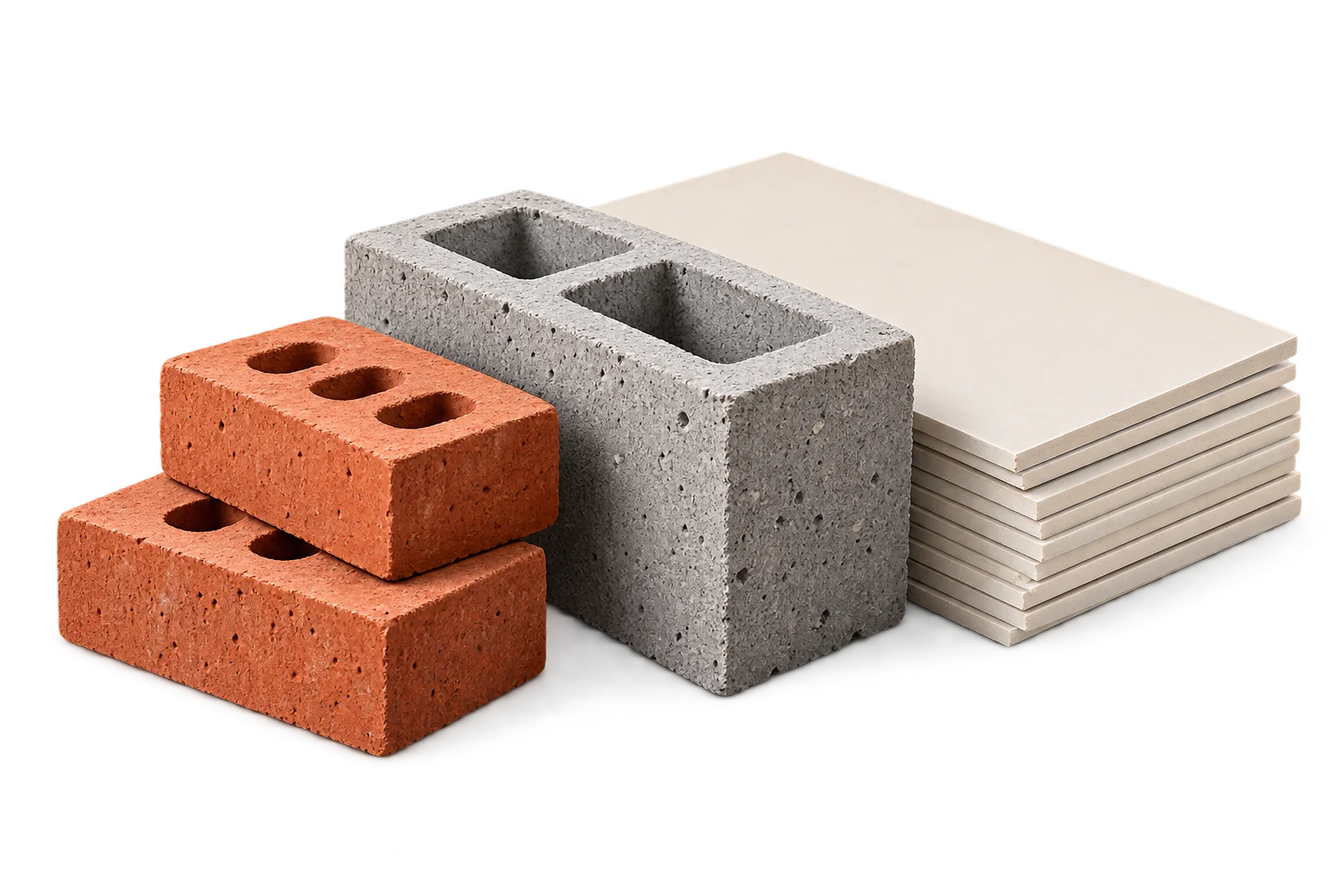
Start with a specified face area
Measure the wall face represented by the estimate and deduct valid openings. The method does not automatically add another leaf, a return, a pier or hidden surfaces. Those need their own measured faces when they are part of the material plan.
Gross wall dimensions, openings and selected unit dimensions should all remain visible. Editing only the final integer count removes the information needed to review the estimate.
Assign joint space to the module
A unit has its own face width and height. Add the vertical joint width to the unit width and the horizontal joint width to the unit height. Their product is the repeated module area.
The distinction between horizontal and vertical joints matters when their values differ. Neither joint is a material thickness or a mortar volume calculation.
Divide adjusted area by the module
Apply the chosen allowance once to the net wall face, divide by module area and round up to a whole unit. This creates an area-based estimate that includes an assigned share of joint space for each repeated module.
For an illustrative 0.39 m by 0.19 m block face with 0.01 m joints, the module is 0.40 m by 0.20 m, or 0.08 m². A 10 m² net face with a chosen 10% allowance requires 11 m²; 11 ÷ 0.08 gives 137.5, rounded up to 138 units.
Why the estimate is not an exact bond layout
A repeated module does not reproduce every wall end or opening edge. Actual end joints, corners, special units and bond arrangements can differ. The model deliberately does not refine those boundary details or promise a complete unit-by-unit layout.
A change in unit size or joint width should therefore recalculate the module. A material name alone cannot establish compatibility between two purchase lines.
Keep quantity and construction design separate
PackLedge does not select wall thickness, foundations, structural loading, retaining details or mortar. An opening can require construction elements that are outside the area count.
Use this calculation to review a quantity against a specification already chosen for the project. Check exact layouts and special-unit requirements separately before ordering.
Frequently asked questions
Why does changing joint width change the estimate?
The joint occupies part of the repeated face module. A larger module covers more modelled face area per unit, while the wall area itself remains unchanged.
Sources and method
- PackLedge quantity methods
Original derivations using geometry, ratios, sums and whole-package rounding. Each calculator explains its assumptions and worked examples.
- Your selected product label or technical sheet
The source for the coverage, mixed yield, density, package capacity, sheet dimensions or wallpaper repeat that you enter.