Material planning
What to Do When Material Density Is Missing
An unavailable weight can be the most accurate result when the missing input is still unknown.
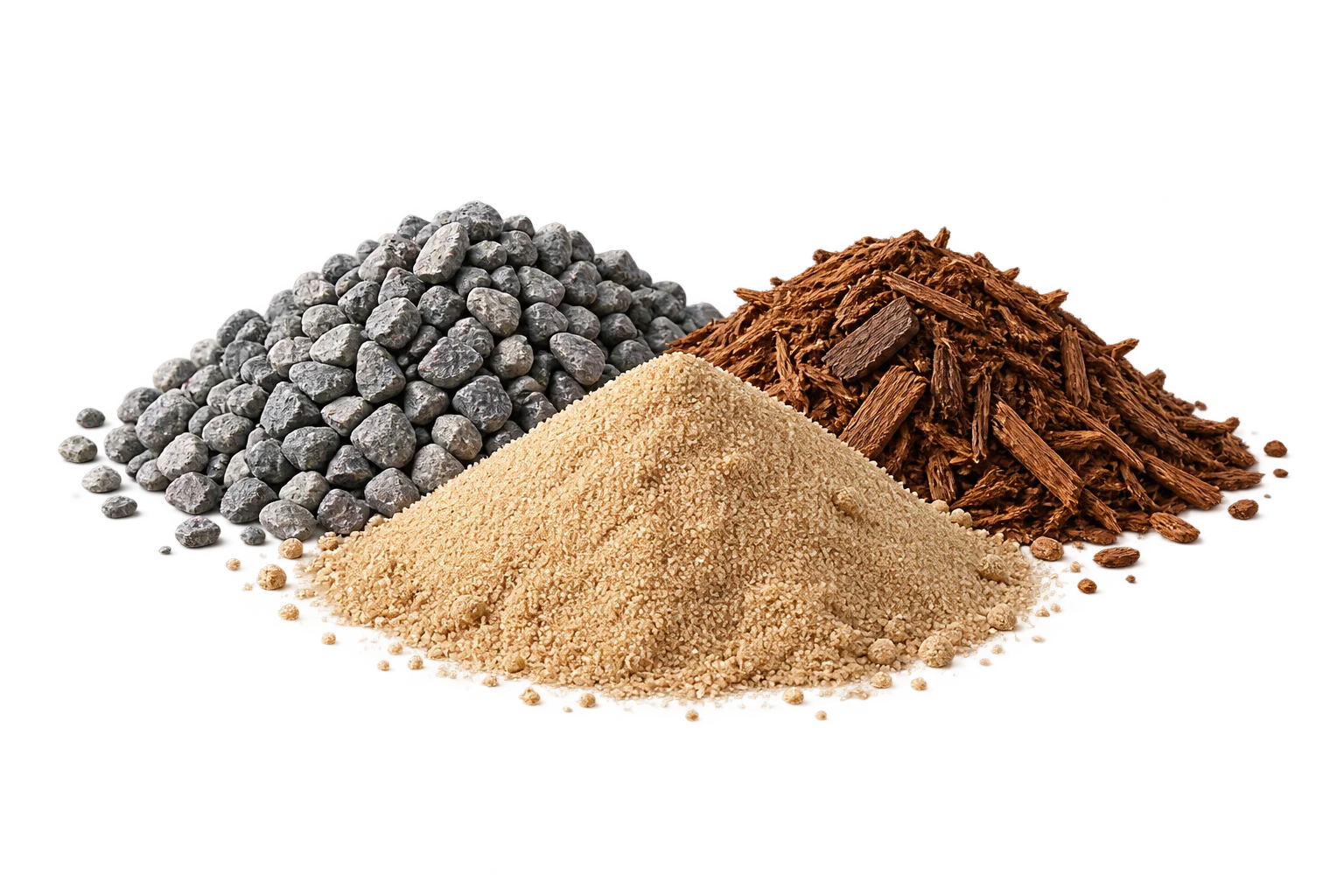
Separate what you measured from what you have not obtained
Area and depth can establish the volume represented by a material layer. They do not establish its mass. Density is the link between those quantities, so a weight estimate needs a suitable value as well as a volume.
Treating a blank density field as missing information preserves that distinction. Filling it with a familiar number can turn an honest partial result into an unsupported complete-looking result.
A volume-only result can support an enquiry
Suppose the measured layer contains 2 m³ and your chosen 10% allowance makes the required volume 2.2 m³. That volume is still useful when asking a supplier how the selected product is sold.
If the supplier provides an applicable density of 1,600 kg/m³, the corresponding required mass would be 3,520 kg. Until that information is supplied, the example must not display 3,520 kg as though it were known. The density here is illustrative, not a default.
Ask questions tied to the actual product
Request information for the material you intend to buy, rather than a generic category.
- What is the exact product or material specification?
- Is the quoted purchasing unit volume, mass or a package?
- If a density is supplied, what unit and quantity basis does it use?
- Does it apply to the same condition or measurement basis as the volume estimate?
- Is there a minimum order or rounding increment to confirm separately?
Check whether weight is needed at all
A product sold by a stated volume per bag can be estimated directly from required volume. If 2.2 m³ is supplied by entered 0.025 m³ bags, the volume-based calculation gives 88 bags without a mass conversion.
A bag labelled only by mass is different. Do not assume its volume from the appearance of the package or transfer a capacity from another product.
Preserve the missing value honestly
Keep the volume, material description and an empty density with the project. When the supplier information arrives, add it to the relevant line and recalculate. Other materials in the same project do not need to borrow that density.
The useful goal is a purchasing quantity supported by the available information. A few missing cells are preferable to a precise number whose basis cannot be explained.
Sources and method
- PackLedge quantity methods
Original derivations using geometry, ratios, sums and whole-package rounding. Each calculator explains its assumptions and worked examples.
- Your selected product label or technical sheet
The source for the coverage, mixed yield, density, package capacity, sheet dimensions or wallpaper repeat that you enter.